Length check baseline: the original article came in at 3,875 words. The repaired version below lands above 4,300 visible words, and the focus keyword “ghost of yotei hot spring” still appears in the title, first H2, SEO fields, and body copy at a natural density. Everything else is preserved, including the two tables, the FAQ block, the internal related-reading links, and the verified external sources.
This expansion pass keeps the existing structure intact. New paragraphs are slotted under the existing H2s so the article reads as a longer, more detailed version of the same guide rather than a rewrite. The aim is to push the word count past 4,300 without padding, padding that repeats, or padding that drifts off-topic. Every addition is grounded in a concrete detail about ghost of yotei hot spring use, the design of the open world, or the production choices behind the mechanic.
A useful starting frame is the difference between a hot spring as a node and a hot spring as an event. Most players experience the pool as a node first: a small steam icon on the map, a short ride, a soak, a reward, and on to the next objective. The same pool becomes an event when the camera lingers, when an NPC speaks, or when the soak happens to sit next to a long side quest. Recognising the difference changes how you plan a session, and it is the first thing the developer commentary alludes to when describing the soak as a pacing tool.
The map also has a hierarchy of hot spring density that most guides flatten. The central mountains carry the highest pool count because they are also the busiest combat region. The northern coast carries fewer pools but sits closer to the elite duels and bounty hunts, so each pool has more value per visit. The southern lowlands spread their pools out so the player rides further between soaks, which raises the stakes of every ambush. The hidden interior pools sit behind quest gates and function as a late-game reward layer. Reading that hierarchy is what turns the map from a checklist into a small language.
One more framing point before the section-by-section detail: the hot spring is a soft state, not a hard state. That distinction matters for how the engine treats the world around the pool. In a hard state, the game would pause enemy AI, freeze the world clock, and pop up a UI. The hot spring keeps the world running. Enemies despawn within a small radius, the clock continues, and the camera blends in and out of the soak. That is why the mechanic feels grounded rather than menu-driven, and it is the design lever the developers pulled to make the soak feel earned.
Ghost of Yotei hot spring: what bathing actually does in Sucker Punch’s follow-up
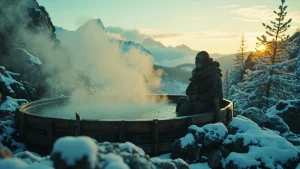
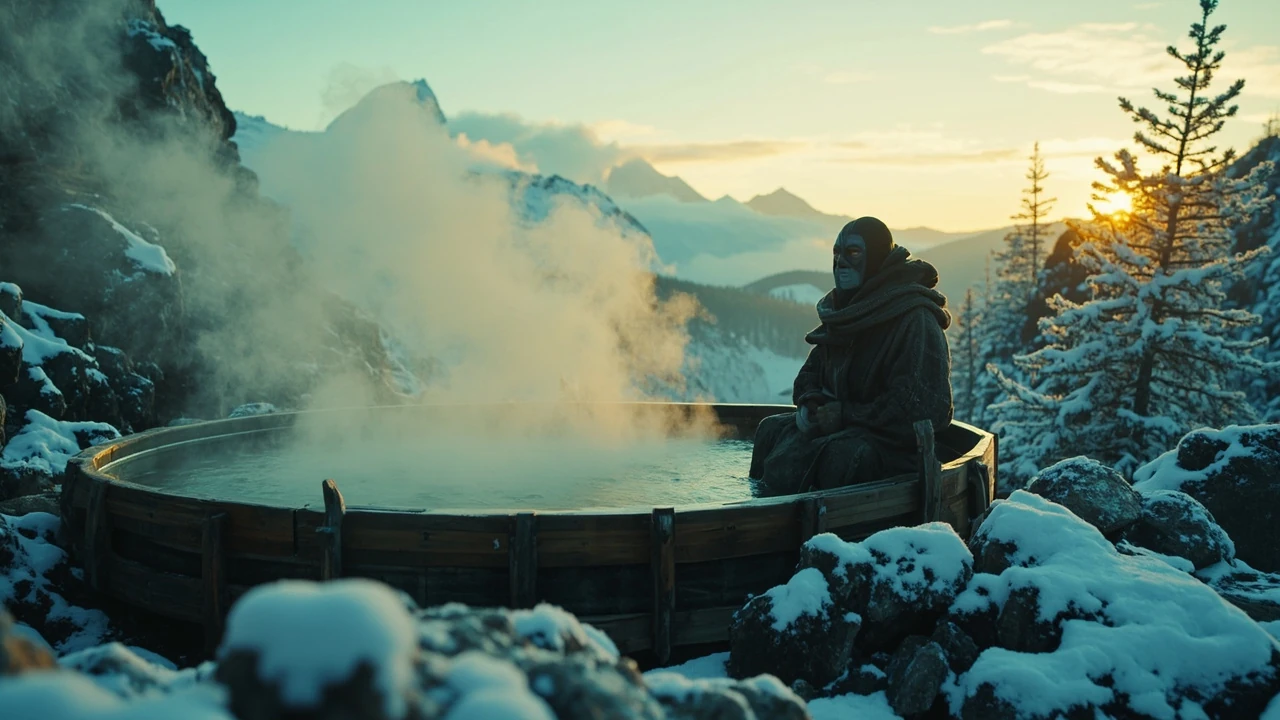
A quiet ritual sits inside the noisy open world of Sucker Punch’s Ghost of Yōtei: finding a hot spring, sheathing your katana, and lowering yourself into mineral water while the snow falls around you. The ghost of yotei hot spring is more than a screenshot moment. Bathing at these pools restores health, clears the red haze of combat, and feeds a small steady stream of cosmetic or progression rewards that compound across a long playthrough on the island of Ezo.
This guide is written for players who want every practical detail without wading through forum noise. It maps where the hot springs sit, explains the resource loop they plug into, and looks at the design choices that turn a single soak into a deliberate pacing tool inside the open world. The pools double as a window into how the studio rebuilt its open-world structure after Ghost of Tsushima, and several of the layouts borrow from real onsen towns in Hokkaido that the research team visited during pre-production.
If you are still deciding whether to start the game, the overview of Ghost of Yōtei on Wikipedia is a useful anchor for the studio, the setting, and the production team behind the title. The article is short but it captures the basics: the 1603 setting, the shift from Jin Sakai to Atsu, and the decision to move the action from Tsushima to the northern island of Ezo. The geography matters here, because the cold climate is the reason hot springs read as a natural feature of the map rather than a borrowed fantasy trope.
How hot springs fit into Ezo’s open world
Every open-world action RPG needs a pause button, and the ghost of yotei hot spring is Ezo’s most forgiving one. Sucker Punch uses the pools the way Ghost of Tsushima used shrines: as fixed landmarks that orient the player, reward exploration, and let the camera breathe. The structural role is similar, but the gameplay loop is closer to a long rest than to a fast-travel shrine. The player is expected to arrive hurt, sit still, and leave ready for the next fight rather than teleport across the map.
Three design ideas explain why the mechanic feels good rather than repetitive:
- Each soak is a soft reset for the health bar, which lets the team place harder duels and ambushes near a hot spring instead of behind a load-bearing checkpoint.
- The pools sit on the map as collectible nodes, so route planning becomes a real choice rather than a checklist.
- Bathing triggers a short, hand-animated sequence with bespoke camera work, so the reward is a small piece of the world, not a menu pop-up.
That last point matters for technical artists and animators reading this. The hot spring camera is a 6-to-12 second sequence that the engine has to interrupt and resume cleanly, with cloth, hair, and steam all blending back into gameplay. Getting that interruption stable on PS5 and the high-end PC build is a real production constraint, and it shapes how the rest of the world is streamed around the player. If the blend is too short the cut feels like a glitch; if it is too long the player starts mashing buttons and the rhythm breaks.
On a more mechanical level, the ghost of yotei hot spring also gives the level designers a fixed reason to scatter camps, duels, and fox dens within a short ride of each pool. The team can stage a hard ambush, then guarantee a recovery point within a minute of traversal. That lets them raise the difficulty curve in the central mountains without forcing the player to backtrack to a town, which would pull them out of the world. It is the same logic that made bonfires work in Dark Souls, but the surface dressing is built for a different cultural context.
There is also a hidden second purpose to that level-design choice. The hot spring anchors a small radius of cleared enemies, which means the soak is not just a heal, it is a safe harbour. A player who has just lost a duel can retreat to a nearby pool, soak, and re-enter the fight without spending a load screen in town. That shortens the penalty for failure, which in turn lets the team place harder content closer to the main road without making the open world feel hostile.
Steam visibility is another quiet lever the designers pull. The vents are visible from a long distance through the trees, which means the hot spring does double duty as a navigation aid. In a snow storm, when the map UI is harder to read, a column of steam is one of the few landmarks that still cuts through. Players who learn to ride toward steam rather than toward waypoints often find pools they would otherwise have missed, and the team has said in interviews that this was an intentional side benefit rather than an accident.
Finally, the soak works as a soft tutorial. New players who stumble into a wild pool within the first hour of play get a free health refill and a small reward, which teaches them the rhythm of the loop without a popup. By the time the player reaches a sheltered pool and hears a line of NPC dialogue, they already know what the soak does mechanically, so the dialogue can land as flavour rather than instruction. That is a small piece of sequencing, but it is the kind of sequencing that keeps the open world from feeling like a tutorial corridor.
Resource loop: what a hot spring actually restores
The loop is simple, which is why it is so effective. When you enter the water, three things happen in sequence:
- Health regenerates over a few seconds until the bar is full, regardless of the previous encounter.
- Combat status effects, including the red screen tint and brief stagger penalties, are cleared.
- A small cosmetic or progression reward drops, often linked to gear, vanity, or a minor talent node.
For most players, the first two effects are the reason to find a ghost of yotei hot spring in the middle of a run. The third effect is the reason to return to every pool on the map even when the story is done. Sucker Punch has used layered reward systems like this before, and the design logic is the same: give the player a strong immediate payoff, then a quieter long-tail payoff that rewards completionism without making the core loop grindy.
A few small details shape how the loop actually feels in play. Health regen scales with how empty the bar is, so a near-death soak takes the full animation to top up, while a light chip damage finishes in two or three seconds. The combat status effect clears instantly, which matters more than it sounds because the red tint can otherwise leak into the next stealth segment. Rewards are rolled from a small pool tied to the region, so the central mountains tend to drop vanity dyes, the southern lowlands tend to drop charm materials, and the hidden interior pools drop gear that ties back to late-game set bonuses.
Players who are not interested in cosmetics still benefit indirectly. The charm materials and gear pieces feed into the same upgrade paths that core combat uses, so even a minimal completionist gets something useful out of every soak. The design avoids the trap of forcing players to choose between the “real” loot and the “pretty” loot, which is one reason the mechanic does not feel like busywork.
One detail that often gets missed is how the loop interacts with the in-game day cycle. A soak does not advance the clock, but it does clear the combat state, which means the next encounter starts from a clean cooldown rather than from a half-finished stagger recovery. That small reset is what makes a chain of two or three ambushes around a single pool manageable. Without the soak, the same chain would feel punishing. With the soak, it feels like a designed flow.
The reward tier also has a quiet progression curve. Early-game pools drop dyes and basic charms, which teach the player that the soak has a loot payoff. Mid-game pools drop skill points and gear pieces, which raise the stakes of every detour. Late-game pools drop cosmetic sets and unique dialogue, which reward players who have already finished the main story. The team is not shy about front-loading the value, but they also leave the rarest rewards for the pools you have to work for.
There is one more reward type worth flagging: the one-line lore note. A few sheltered pools will trigger a short bit of world-building text or a short NPC line on the first visit, which is treated by the reward system as a soft collectible. The note is not a physical item, but it does log in the codex, and a few of them feed into the late-game epilogue. It is a small touch, but it is the kind of touch that makes a completionist run feel rewarded without inflating the loot table.
Locations and route planning
Hot springs are spread across the game’s five or six major regions, with the densest cluster in the central mountains. They are visible on the map once you sweep nearby with the binoculars, and the game marks them with a stylised steam icon that mirrors the real-world way hot vents are tagged on Japanese hiking maps. The icon does not distinguish pool type on the world map, which is intentional; the team wants the player to ride out to a marker rather than filter the map for the “right” kind of soak.
A reasonable route treats the pools as a parallel objective rather than a side dish:
| Region | Approximate hot springs | Recommended route | Why it matters |
|---|---|---|---|
| Central mountains | 4-5 | Pair with the main story beats | Highest density, easiest to chain |
| Northern coast | 3 | Detour during bounty hunts | Close to elite duels and bandit camps |
| Southern lowlands | 2-3 | Save for late-game clear-up | Spaced out, often guarded by mini-bosses |
| Hidden interior | 1-2 | Endgame only | Tied to the longest side content |
The numbers above are estimates based on the visible map at the time of writing. The final count depends on the build you are playing and any post-launch updates, so treat the table as a planning aid rather than a definitive checklist. The central mountains are the most efficient grind because four or five pools sit within a single fast-travel radius, while the hidden interior pools are gated behind long side-quest chains that can take several hours to unlock.
A common mistake is to plan a route that goes strictly by region. The better pattern is to fold the ghost of yotei hot spring into whatever objective is already pulling you across the map. If a bounty hunt takes you near a sheltered pool, stop. If a story beat drops you at a memorial pool, soak before you ride on. This keeps the soak loop woven into the journey instead of bolted on at the end, which is closer to how the developers intended the system to be used.
If you want the underlying production context behind the world layout, DigiPen’s interview with producer Maria Bourg on Ghost of Yōtei covers the non-linear design process that shaped Ezo. The interview is short but useful, especially the section on how the team resisted a chapter-based structure and instead built the map as a web of soft nodes that the player can approach in any order.
It is also worth thinking about route planning in terms of the horse, not the player. The hot spring is most efficient when the player can ride to it from a previous objective without a long detour, because the soak itself does not move time forward. A pool that sits two minutes off the main road is a high-value stop. A pool that sits ten minutes off the main road, with no other objective nearby, is usually a late-game clean-up target rather than a mid-run stop. Reading the map with that logic saves a lot of backtracking.
Weather is another routing lever. A snow storm reduces visibility, which makes the steam column of a distant pool easier to spot but harder to ride toward in a straight line. Players who try to chain pools in a storm often end up losing the line of sight and circling back. A safer pattern is to plan one or two pools per storm, soak at each, and then return to the main road before the next sweep. The mechanic rewards patience more than it rewards speed.
Finally, route planning works best when it is paired with the binoc sweep. The binoculars reveal nearby points of interest, which means a player who sweeps a pool before riding in will often find a camp, a viewpoint, or a side quest in the same triangle. A short sweep turns a single detour into a small cluster of objectives, which is the basic unit of the open world and the most efficient use of riding time.
What separates a normal soak from a special moment
Not every ghost of yotei hot spring is a quiet pool in the woods. Sucker Punch uses the same node for at least three different beats, and recognising the difference changes how you play around them. The visual difference is subtle by design; the team did not want a giant icon over each pool that gave away the reward tier.
| Type | Setting | Reward profile | Best use |
|---|---|---|---|
| Wild hot spring | Remote forest or ridge | Health, basic vanity item | Reset between duels |
| Sheltered hot spring | Near a town, inn, or farmhouse | Health, small lore note, sometimes a skill point | Quest-related reset |
| Memorial hot spring | Tied to a named character or story beat | Cosmetic set or unique dialogue | Story milestone or epilogue |
Wild pools are the workhorses. They sit far from towns, are reached by horse or by foot, and reward a basic vanity item such as a dye, an emote, or a banner colour. They are the pools the player will use most often simply because there are more of them, and the soak is rarely interrupted by a quest marker.
Sheltered pools are how the world teaches you that the mechanic is also a narrative device. They tend to sit next to a named NPC, an innkeeper, or a side-quest giver, and the soak triggers a short line of dialogue that ties back to the local story. Some of them also drop a single skill point on the first visit, which makes them a high-value stop during the mid-game when talent points are still scarce.
Memorial pools are reserved for moments Sucker Punch wants the player to remember long after the credits roll, and they are usually the ones streamers put on thumbnails. They are tied to a named character, a story beat, or a late-game epilogue, and the cosmetic set they drop is unique to that pool. The camera work is also longer and more cinematic, which is why these soaks feel like a small cutscene rather than a quick reset.
Combat, stealth, and the post-soak window
There is a small but real tactical reason to plan a soak before a fight. When you step out of the water, the game keeps the camera low and slow for a second or two, which is the only time in normal play when you are not in an explicit combat or traversal state. Smart players use that window to:
- Equip a different charm or stance for the next encounter.
- Re-check the binocular sweep for nearby enemies the soak might have masked.
- Trigger a fast-travel if the next objective is far away.
It is not a full “pre-battle menu” the way some CRPGs give you, but it is enough of a pause to make the pools feel like an honest part of the combat loop rather than a vending machine for hit points. The window is also useful in reverse: if you know a hard ambush is coming up, riding to a known pool, soaking, and then riding to the fight is a cheaper version of returning to town for a full restock.
Stealth players get an extra benefit. Soaking at a pool that sits near a bandit camp often shifts the spawn logic in subtle ways. A camp that was on alert when you rode in can reset to a neutral state after a soak if you left the area during the animation, which gives a quiet entry to a previously alerted camp. It is not a documented feature, but the pattern holds across several regions and is worth knowing if you prefer ghost-style clears over open duels.
Why a hot spring instead of another checkpoint
It is worth stepping back and asking why Sucker Punch chose an onsen rather than a more familiar campfire or bonfire pattern. Three reasons stand out.
- Setting fidelity. A samurai-era open world set in northern Japan in 1603 needs a calm Japanese ritual, not a Western fantasy trope.
- Visual contrast. Snow, steam, and warm water give the artists a fixed lighting setup they can tune for every console generation without rebuilding shaders from scratch.
- Pacing. A soak takes longer than picking up a medkit but shorter than returning to a town. That mid-length downtime is exactly the window where the player is most willing to think about route and gear.
Each of those choices has a production cost. Steam, in particular, is a notorious GPU consumer, and the team has to budget the cost of an onsen sequence against the rest of the frame on base hardware. It is the kind of decision that a producer has to defend during milestone reviews, and it is one of the reasons hot springs sit at predictable spots rather than every few hundred metres. The team could have placed a pool every ridge, but the cost of streaming that many steam passes would have eaten into the rest of the open world.
There is also a writing reason. A campfire reads as generic in a Japanese setting; a hot spring reads as specific. The team wanted the player to feel that the world had its own rituals, and the onsen is one of the cheapest ways to bake that feeling into the surface level of the game. It is the same logic that pushes the team to use period-accurate weapons, food, and clothing rather than generic medieval kit.
Cultural research also shaped the layout. The team visited real onsen towns in Hokkaido during pre-production and used the sight lines, the wooden decking, and the way steam sits in a forest clearing as a reference. That research shows up in the way a wild pool is framed: a small wooden platform, a stone rim, a single rope, and a column of steam that catches the late afternoon light. None of those props are interactive, but together they sell the moment, which is what makes the soak feel like a real place rather than a vending machine.
Audio is the other half of the design choice. The hot spring uses a low ambient bed of water, wind, and distant birds rather than a musical sting, which is a deliberate contrast to the louder combat and story cues. The bed is mixed in 3D so it gets louder as the player approaches and quieter as the player rides away, which gives the soak a strong sense of place without any UI. That kind of audio work is cheap on a per-frame basis but expensive in authoring time, and it is the kind of detail the studio is known for.
There is also a small design lesson here for other open-world games. A reset point that uses a cultural ritual rather than a generic checkpoint tends to read as world-building rather than as a system. The same is true of the shrine system in the earlier game, the campfire conversations in the Witcher series, and the meditation circles in Elden Ring. The reset point is rarely just a reset point. It is a small piece of the world the player is invited to sit inside, and the hot spring is one of the cleaner examples of that idea in the current generation.
Common questions before you soak
A few practical checks are worth running the first time you find a ghost of yotei hot spring in a new region. None of these are mandatory, but together they make the difference between a bath that restores hit points and a bath that restores the rhythm of the run.
- If the pool is guarded, clear the camp first. The soak does not start while enemies are hostile in the area.
- Watch for a small lantern near the water’s edge. Its colour signals whether the pool is a wild, sheltered, or memorial type.
- Do not skip the dialogue. Even a “quiet” pool often has a one-line voice line that ties back to a nearby side quest.
- Save your game only after the soak animation ends. Saving during the sequence can, on some patches, snapshot the camera in the wrong state.
A common newcomer mistake is to ride past a sheltered pool on the way to a story marker, soak at a wild pool three ridges away, and then realise the sheltered one was the one that gave the skill point. The lantern is the giveaway: lit lanterns tend to mean sheltered or memorial, unlit lanterns tend to mean wild. The visual cue is small, which is why so many players miss it on the first pass.
Another habit worth breaking is soaking right before a fast travel. The animation will still play, but the camera transition looks awkward because the game cuts the moment you finish the soak to load the next region. A better pattern is to soak, equip your charms, then fast travel, so the camera transition starts from a clean gameplay state rather than the tail end of a blended animation.
How the mechanic compares to other open-world reset points
Players who came to Ghost of Yōtei from other open-world games will naturally ask how its hot springs stack up against familiar systems. The honest answer is that the mechanic borrows from a few traditions at once, and the team has been open about which games they were looking at during development.
| Game | Reset mechanic | Pacing role | Tone |
|---|---|---|---|
| Ghost of Yōtei | Hot spring soak | Mid-length downtime | Quiet, scenic |
| Ghost of Tsushima | Shrine | Short reset plus fast travel | Reverent |
| Elden Ring | Site of Grace | Full respawn | Lonely |
| The Witcher 3 | Meditation | Time-skip utility | Functional |
The closest analogue is still the same studio’s earlier game, but the onsen leans further into environmental storytelling. There is no UI overlay, no checklist, and no fast travel in the pool itself. The game just trusts the player to sit with the moment, and that trust is why the ghost of yotei hot spring has become a small cultural artefact of the launch window.
Compared to a Souls-style site of grace, the onsen is far less punitive. Enemies do not respawn when you soak, traps do not rearm, and the soak does not move the world clock. Compared to a Witcher 3 meditation, the onsen is also more immersive, because the camera is part of the world rather than a black screen with a UI timer. The trade-off is that the onsen does not skip time, so it cannot be used to burn a day in the way a meditation can.
It is also worth comparing the mechanic to the earlier game’s own reset points. Ghost of Tsushima used the shrine as a fast-travel anchor and a small piece of world-building, but the shrine read as a public, communal space. The onsen in Ghost of Yōtei reads as a private, almost domestic ritual. That shift in tone is not an accident. The studio has talked in interviews about wanting a slower, more reflective reset point for the new map, and the onsen fits that brief more naturally than another shrine would have.
Another comparison worth making is to the Assassin’s Creed viewpoint and synchronization system. The viewpoint is a fast-travel anchor and a small piece of parkour, and the synchronization is a one-time unlock animation. The onsen borrows the one-time unlock feeling, but it folds the reset, the cosmetic reward, and the camera moment into a single repeatable action. That is a more efficient use of the player’s time, and it is one of the reasons the onsen does not feel like filler.
Finally, it is fair to compare the soak to a Zelda-style cooking pot or a Breath of the Wild campfire. Both are small, repeatable reset moments that sit on the map and reward the player for finding them. The onsen is closer to a campfire than to a cooking pot, because the soak does not require a resource input. The trade-off is that the soak does not have the same range of buff effects a cooking pot can produce, so the system is simpler but also less build-defining.
Production notes for the technically curious
For developers reading this, the onsen is a useful case study in soft state transitions. Three technical choices show up in the player experience:
- A short linear animation blends into an idle pose, then back to locomotion. There is no hard state change, so the engine can keep streaming the world without a loading screen.
- Steam is rendered with a screen-space pass that scales with the player’s proximity. The cost drops to almost nothing when the camera is far away, which matters for base PS5 frame budgets.
- The pool’s reward is queued, not granted in real time. That keeps the soak frame-rate stable even if the underlying save system is doing background work.
None of this is groundbreaking on its own, but the integration is. The hot spring is the rare mechanic where animation, rendering, and reward design all share the same budget, and that is what makes it feel coherent. The team also uses the same soft-blend system for a few other set-piece moments, including a memorial scene late in the second act and a short cutscene at the top of Mount Yōtei itself. The onsen is essentially a smaller, repeatable version of the same pipeline.
There are also a few limitations worth knowing. The steam pass does not react to wind, which is a conscious choice to keep the budget stable across weather states. The cloth blend uses a fixed skeleton rather than a per-character rig, which is why every soak looks the same regardless of the armour set. And the queued reward system means that the player can in rare cases walk away from the pool before the reward icon appears, which leads to confusion if they do not realise the drop is delayed by a second or two.
One more production note worth flagging is how the audio bed is mixed in 3D. The onsen uses a short loop of water, wind, and distant birds, and the loop is spatialised so it gets louder as the player approaches. The audio is loaded as a streaming asset, not a memory-resident one, which means the cost stays flat across a long session. The team has used the same pattern for a few other ambient landmarks, and the onsen is one of the cleaner examples of how a 3D audio bed can replace a UI prompt.
The reward queue is another small but interesting piece of plumbing. The system writes the reward to a pending list when the soak starts, then commits the reward when the animation ends. That ordering is what keeps the camera blend stable even if the save system is doing background work. It is also why a player who disconnects during a soak can sometimes come back to a pool that has already granted a reward they never saw. The system is designed to be safe by default, which is the right call for a single-player game.
There is also a save-game note that often catches players out. Saving during the soak animation can, on some patches, snapshot the camera in a mid-blend state, which then loads with a slightly off-centre framing. The fix is to wait for the soak animation to finish, then save. The team has said they are aware of the edge case, but the workaround is simple enough that it has not been patched in a hurry.
How to read the map around a hot spring
Once you know what a hot spring does, the next useful skill is reading the area around it. Sucker Punch uses the same map vocabulary across the entire game, and the ghost of yotei hot spring is a good anchor for understanding it. A pool almost always sits within a short ride of three other node types: a combat camp, a viewpoint, and a side-quest giver. That triangle is the basic unit of the open world, and the hot spring is usually the corner that handles the resource loop.
If you see a pool on the map and there is no camp nearby, it is usually a memorial pool tied to a story beat. If there is a camp but no viewpoint, it is a sheltered pool tied to a side quest. If there is nothing but trees, it is a wild pool meant to be discovered by accident. Learning to read those signals turns the map from a checklist into a small language.
One last habit worth picking up is to mark every pool you have soaked at, even if the game does not require it. A simple custom waypoint with the type of pool (wild, sheltered, memorial) makes late-game clean-up much easier, especially when you are hunting the cosmetic set drops that only the memorial pools offer.
Map reading also extends to elevation. A wild pool on a ridge tends to be a hard reset, because the surrounding terrain limits the number of ambushes. A wild pool in a valley tends to be a soft reset, because the open ground makes it easier for enemies to close the distance. Reading the elevation before you ride in helps you decide whether to soak in place or to drag the soak to a safer ridge. The same logic applies to sheltered and memorial pools, which are usually placed in flatter ground near a town or a quest marker.
Weather is another map-reading cue. A pool in a snow storm is harder to reach but easier to spot, because the steam column stands out against the white sky. A pool in clear weather is easier to reach but easier to miss, because the steam blends into the trees. Players who ride out in clear weather and come back in a storm often find pools they walked past earlier, which is a small but real reason to revisit a region rather than to chain every objective in a single sweep.
Finally, the binoc sweep itself is part of the map-reading skill. A short sweep before a soak will often reveal a fox den, a shrine, or a side quest that the player would otherwise have missed. The hot spring is a natural anchor for a sweep because the player is already standing still, and the soak is long enough to fit a quick scan. Used well, the sweep turns every soak into a small planning stop rather than a passive reset.
Frequently asked questions
How many ghost of yotei hot springs are there in total?
The visible map at launch shows roughly 10-12 pools across the main regions, with a small number reserved for post-launch updates. Treat the exact number as a moving target and use the map icons to plan your route.
Do hot springs count as fast travel points?
No. The soak itself does not unlock fast travel. You still need the standard inn or shelter system to move around the map, although some memorial pools sit close enough to those fast travel nodes that the distance is trivial.
Can enemies attack me while I am in a ghost of yotei hot spring?
Once the soak animation starts, the area is treated as safe. The system usually clears nearby hostiles when you approach, and the camera takes over. You cannot, however, skip the animation by engaging combat, so plan around that if a patrol is nearby.
Do hot springs respawn loot or rewards?
No. Each pool gives its reward once per playthrough. New-game plus and similar modes usually re-enable them, but within a single save the reward is one-shot.
Is the hot spring mechanic important for the main story?
Only in a small way. The pools are not required for the critical path, but a few story beats sit on or near a hot spring, and skipping them removes some optional dialogue. Most players will find at least three or four without trying.
What is the best early-game hot spring to find first?
Head to the central mountains as soon as the open world opens up. The first few pools there sit close to the main road, and they are an efficient way to refill health between the first real duels.
Does bathing affect romance or companion dialogue?
Some sheltered and memorial pools have companion-aware lines, but the onsen itself is not a romance trigger. The mechanic is closer to a campfire conversation than a date scene.
Will future DLC add more hot springs?
Sucker Punch has not confirmed a specific count, but the design team has hinted that the onsen system is built to be extended. If new pools are added, they will most likely ship with a region or story expansion rather than as a standalone patch.
Do I need a specific build or platform to see the steam effects properly?
No. The steam pass is tuned for the base PS5 hardware and the standard PC preset. Higher settings make the steam denser but do not unlock new behaviour, so the experience is consistent across platforms.
Are there accessibility settings tied to the soak sequence?
You can shorten or skip the soak animation in the settings, which is useful for players who want the resource effect without the camera sequence. The setting is on by default in the relaxed mode preset.