Arc deforester blue gate: what the encounter actually is
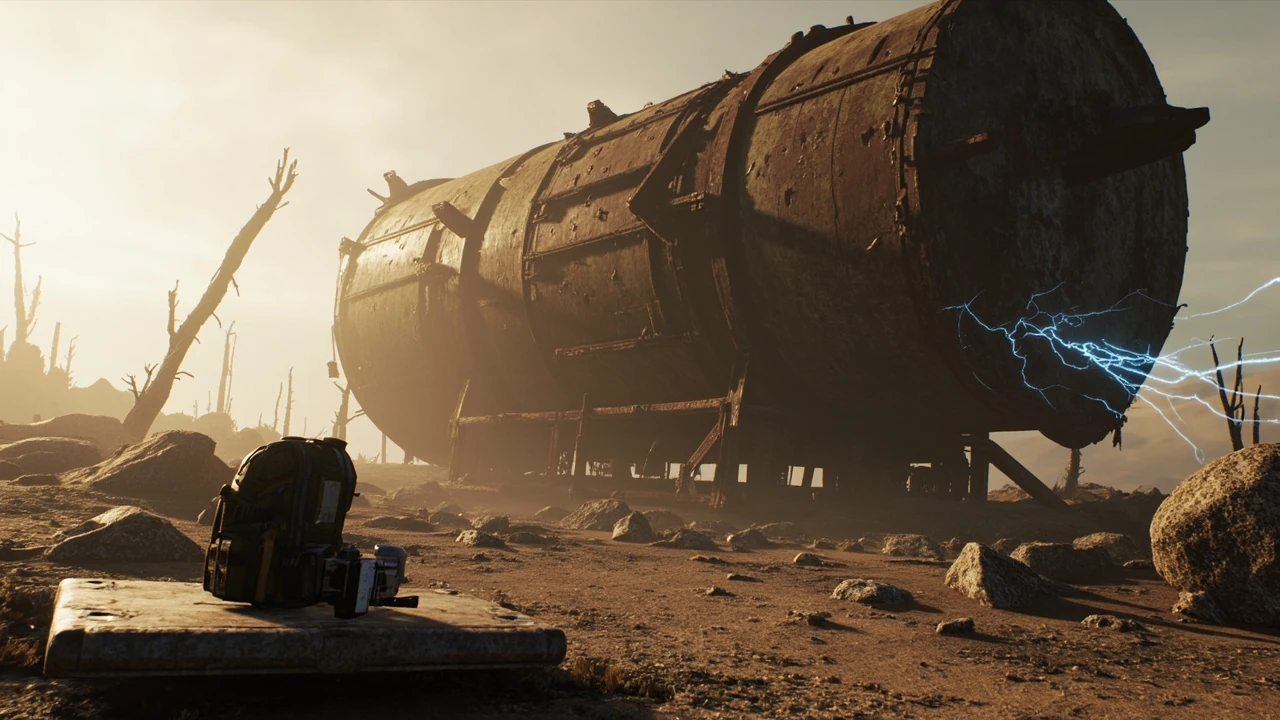
The arc deforester blue gate encounter is a fixed quest event on the Blue Gate map in Arc Raiders, introduced as part of the Headwinds update. The Headwinds patch added seven new quests to the game, and the relevant one here, A Prime Specimen, sends players to a large cylindrical machine wreck on the map. The objective at the wreck is to interact with a circuit in the lower body of the cylinder, then climb to a small platform that sits above it. The visual reference is the same type of wreckage the community calls the arc deforester: a heavy industrial unit that, in the fiction of the game, was originally built to clear forested terrain before the surface changed. For quest purposes it is a static landmark, not a hostile unit, which is part of why this particular step feels different from the other Headwinds additions.
From a developer angle, the arc deforester is also a useful case study. It is treated as a shared environmental prop rather than a unique NPC, so the quest logic depends on the player’s ability to detect and interact with a generic mesh. The event trigger is client-side and based on proximity, not on a unique actor, which is one of the reasons the community has reported the event failing to fire on the first approach. The reward chain matters too: the quest feeds into broader Headwinds progression, and the items the player brings into a raid matter as much as the items they pick up on the map. Understanding that flow is what separates a clean run from a wasted one.
This walkthrough is written for players who already understand the basics of Arc Raiders raids, but the explanations are framed in production-style terms where it helps. Each step below also describes what the engine is doing, so designers and technical players can see why the encounter has a reputation for being unreliable, and what to check when the trigger does not behave as expected.
Quest prerequisites and what to bring into a raid
Before chasing the arc deforester blue gate objective, a small amount of preparation is required. The first quest step is to obtain two Arc Powercells, which are the common crafting material used to build shield charges. Most players already have a stockpile, so the practical first step is to make sure two are staged in a backpack and ready to take into a raid. If a player does not already have any, the cells can be harvested from any Arc machine on the map, including the standard wreckage nodes that drop crafting resources.
The second, often underestimated, prerequisite is squad coordination. The arc deforester event requires a player to physically climb to a platform above the wreck, which means the climb is exposed. Solo players should treat the encounter as a one-shot-per-raid opportunity rather than something to retry mid-raid, because the climb leaves a player stationary and visible from a long distance. A two or three-player squad makes the encounter dramatically safer, because one player can keep overwatch while the other climbs. If a third player is available, they can act as a flanker to cover the angles the overwatch player cannot watch.
The third prerequisite is map familiarity. The arc deforester event can be triggered at any of the three Blue Gate locations, but the climb direction, the cover layout, and the approach distance differ at each one. A player who only knows the westernmost wreck can waste a run walking to a second location if the first one does not register. It is worth learning at least two of the three before queuing specifically for this quest, so that a failed trigger at one site can be recovered at another without a long detour.
Useful pre-raid checklist for the arc deforester blue gate quest:
- Two Arc Powercells staged in a backpack before queuing for a raid
- At least one healing item and one shield charge crafted in advance
- Mid-range or close-range weapon with reliable damage at fifty meters
- Comms plan with squadmates, including a designated overwatch player
- Confirmation that the squad is heading to Blue Gate, not Dam or another map
- Knowledge of at least two of the three deforester spawn sites
None of these items are quest-specific drops, and the quest does not consume the cells at the moment of interaction. The cells are used in the first hand-in, not at the deforester itself, which is a detail many players misremember after their first attempt and which leads to the false belief that the climb should consume them.
The three arc deforester locations on Blue Gate
There are three arc deforester spawn points on the Blue Gate map. They are not random; they are fixed landmarks, and the quest will accept any of them as the trigger point. Knowing the difference between them is what makes the difference between a one-raid completion and a multi-raid grind, because the time spent walking between sites is usually the deciding factor in whether a run feels productive.
Based on the published walkthrough for A Prime Specimen, the three locations are:
- Adorned Wreckage, western Blue Gate: the westernmost of the three, set among the more decorated wreckage that gives the area its name, with the most immediate cover and the shortest approach from a typical western drop
- Barren clearing, west-central Blue Gate: a more open site with less cover, but easier line of sight for an overwatch player and a flatter approach that does not require vertical movement
- Ridgeline, eastern Blue Gate: a higher site that requires more vertical movement to reach, but tends to attract fewer random patrol routes and has clearer sightlines to the south and east
Players can pick any of the three, and the engine does not care which one triggers first. The practical advice is to go to whichever site matches the squad’s drop and avoid backtracking across the entire map. If the squad spawns near the western side, Barren clearing is usually the closest option. If they spawn near the east, Ridgeline is the more efficient choice. Adorned Wreckage is the natural fallback for a western drop when Barren clearing is occupied, and it tends to be the least contested of the three because the decorative wreckage makes the climb slightly more awkward to read at a glance.
Step-by-step encounter flow at the arc deforester
Once the squad reaches a deforester, the encounter has three discrete steps. They look simple, but each one has a small failure mode that is worth understanding before the run starts.
Approach and proximity trigger
Walk the player character close to the wreck. There is no visible quest marker on the deforester itself, because the quest tracking in Arc Raiders is layered onto the map UI rather than placed on the world geometry. As soon as the player crosses an internal proximity radius, the event becomes interactable. If nothing happens on approach, the player is almost certainly outside the radius. The radius is roughly a player-length away from the base of the cylindrical body, not from the high platform that sits above the wreck, so approaching from the climb side and looking up is the most common way to miss it.
Interact with the circuit in the main body
The actual interaction point is on the main body of the deforester, near the lower section, not on top. The walkthrough describes this as a circuit embedded in the cylinder. Players will see a short electric animation when the interaction fires, which is the visual confirmation that the event has been registered. If no animation plays and the prompt does not appear, the event has not been queued. The two usual reasons are: the player is not yet inside the trigger radius, or the event is in a session-level cooldown after another squad used the same site. The community reports that cooldowns are inconsistent, which is what gives the quest its buggy reputation.
Climb to the platform above
Once the circuit has been triggered, the player needs to climb to the small platform that sits above the deforester. The climb is a fixed geometry path, not a free-form jump puzzle, and it has handholds that any character can use. The climb exposes the player for several seconds. This is the highest-risk part of the encounter, and it is the part where the overwatch player matters most. A second player should watch the ridgelines and the road while the first climbs, and the climbing player should not start the climb until overwatch has called the area clear. If the climb is interrupted, the player can usually restart it immediately, provided they are still on the climb geometry and have not been knocked off.
Why the event sometimes refuses to trigger
The arc deforester blue gate encounter has a strong reputation for being buggy. Public coverage of the quest describes the issue directly: the quest event does not always fire when a player reaches the deforester, and the only community-supported workaround is to try a different deforester, end the run, and start a new one. That is not an ideal fix, but it is the only one currently confirmed by public reporting on the quest, which is worth keeping in mind before a player assumes their own setup is wrong.
From a design and engineering perspective, the failure mode is consistent with how the game tends to handle shared environmental events. The arc deforester is a generic wreck, not a unique quest actor. That means the trigger is almost certainly a proximity volume on a reusable mesh, and the completion flag is almost certainly stored per session rather than per actor. When two squads are in the same general area, or when the session has just rotated in, the volume can be in a state where the player’s interaction is silently rejected. There is no on-screen error; the prompt simply does not appear, and the player has no way to know whether they are out of range or whether the event is on cooldown, which is part of what makes the quest feel so opaque on a first attempt.
Players who want to minimize wasted runs can follow three habits that have been reported as improving trigger consistency:
- Approach from the side that gives the clearest line of sight to the lower circuit, rather than from the climb side
- Wait a full five seconds after arriving at the deforester before attempting the interaction, to give the session a moment to settle
- If the first attempt fails, walk the player character ten meters away and back in, which retriggers the proximity check without ending the run
None of these are guaranteed fixes, but they are the patterns that have been most consistently reported as improving the trigger rate. The community’s other workaround, switching to a different deforester, remains the most reliable in cases where a single location is stuck, and the PC Gamer writeup of the quest points to that exact approach as the only solution in its current state.
Common failure modes and how to debug them mid-raid
Even with a clean approach, several things can go wrong. A small diagnostic framework helps because the game does not give explicit error states, and most of the time the player is left to figure out from context whether the event is broken, the radius is wrong, or the quest is not the active one.
The interaction prompt never appears
This is the most common symptom. The player is standing next to the deforester, looking directly at the lower body, and nothing happens. The first check is whether the quest is actually the active tracked quest. If a player has multiple quests selected in the menu, only the top one gets the highlighted prompt, and some interactions only become visible when the matching quest is the active one. Switching the active quest to A Prime Specimen resolves this in many cases. If the quest is already the active one, the player should move five meters away, wait a beat, and reapproach. If it still does not fire, the event is in a stuck state and the player should rotate to a second deforester, because forcing the interaction rarely recovers it.
The circuit animation plays but the climb is greyed out
Less common, but reported. The lower interaction fires, the electric arc plays, and the climb prompt does not appear. This usually means the second half of the event has not yet propagated through the session. The fix is the same: leave the area briefly and return. The climb is a separate interaction from the circuit, which is part of why the event has a two-step registration model and why the two halves can desync.
The climb starts but the player is interrupted
Mid-climb interruptions are almost always caused by damage from another squad or a patrolling Arc. The overwatch player should be watching the high ground before the climb starts, and the climbing player should not begin the climb until overwatch confirms the area is clear. If the climb is interrupted by a stagger, the player can usually restart it immediately. If the climb is interrupted by lethal damage, the squad should reset and the climbing player should redeploy in a future run rather than burning the rest of the raid trying to recover the same step.
The player completes the event but the quest does not advance
This is the rarest case, but it does happen. The climb completes, the player reaches the platform, and the quest tracker does not move. The most consistent workaround is to fast-travel out of the area and back in, which forces a tracker refresh. If that does not work, ending the run and starting a new raid almost always resolves the issue, because the tracker reset on session transition is the cleanest way to flush whatever state the quest server is holding.
Squad composition, roles, and positioning
The arc deforester blue gate encounter is one of the more position-sensitive Headwinds quests. The climb is fixed geometry and the trigger is proximity-based, which means the squad’s positioning has to be deliberate. The roles below are patterns that have worked in reported runs, not a hard class system, because Arc Raiders does not lock players into traditional MMO roles and any player can fill any role as long as they have the right gear staged.
Climber
One player climbs. This player should be the squad’s most mobile and most familiar with the climb geometry. They should carry one healing item and one shield charge in case they take damage mid-climb. They should not be the squad’s primary sniper or heavy-weapon user, because climbing with a heavy weapon is possible but reduces mobility if the climb is interrupted and forces the player to swap weapons while exposed on the platform.
Overwatch
One player takes a high position within line of sight of the deforester, ideally behind a rock outcropping or wreckage that does not block their own view. Their job is to track movement on ridgelines and call targets to the squad. The overwatch player should be the squad’s longest-range combatant, because most threats will come from fifty meters or more and a close-range loadout will struggle to punish an enemy before they close the distance to the climber.
Scout or flanker
If the squad has a third player, they should take a position that is perpendicular to the overwatch player’s line of sight, so that incoming threats can be engaged from two angles. The flanker should not stand in the same arc as the climber or the overwatch, because clustered positioning turns the encounter into a single-funnel fight. A good flanker position is one that covers the road approach to the deforester from the opposite side of the overwatch, so any squad pushing in has to deal with crossfire.
Comparison with the other Headwinds quests
The Headwinds update added seven new quests, and the arc deforester blue gate quest stands out for several reasons. A quick comparison helps frame where the encounter sits in the Headwinds progression and which quests it pairs well with in the same session.
| Quest | Map focus | Risk profile | Main failure mode |
|---|---|---|---|
| A Prime Specimen (arc deforester blue gate) | Blue Gate, fixed landmark | Medium to high during climb | Event does not trigger, requires retry or site switch |
| Movie Night | Shredder den on a high-tier map | Very high due to Shredder density | Player runs out of ammo or healing before reaching the objective |
| With a View | Map-wide, requires specific Exodus items | Medium, item-gated | Player does not have the required Exodus items in their inventory |
The table makes the trade-offs concrete. The arc deforester quest is safer than Movie Night because it does not require fighting through a Shredder den, but it is more frustrating than With a View because the trigger can silently fail. Players who are grinding all seven Headwinds quests in one session should plan to alternate between item-gated and event-based quests, because two event-based quests in a row is the pattern most likely to produce a string of failed triggers, and item-gated quests give the squad a chance to reset their mental model before the next trigger attempt.
Inventory and economy considerations
The arc deforester blue gate quest has a relatively light inventory footprint compared to other Headwinds quests. The two Arc Powercells are the only quest-specific input, and the climb does not consume any consumable. That makes the quest a good fit for a run in which the squad is light on resources. It is also a reasonable choice for a player who wants to focus on a single objective rather than spread attention across multiple quest chains, because the quest has a clear binary state at each step: either the trigger fires or it does not, and either the climb completes or it is interrupted.
Players should still avoid bringing their best gear. The climb leaves a player exposed, and a death on the platform means the squad loses a fully kitted player for the rest of the run. The recommended load for a dedicated arc deforester run is:
- One mid-tier weapon for general combat
- One close-range weapon for any close encounters during the climb
- Two Arc Powercells staged in the backpack
- One healing item and one shield charge
- Standard ammo for the chosen weapons, no experimental ammo
- Optional: a single throwable for area denial while the climber is on the geometry
This load is a deliberate balance. It keeps the climb viable without risking the squad’s best loot on a single quest step. A common mistake is to bring a high-tier weapon and then lose it on the platform, which is a much more expensive outcome than the two Powercells the quest actually requires.
How the encounter fits into the broader quest chain
The arc deforester quest is part of the Headwinds progression, which feeds into the broader Arc Raiders endgame. The Headwinds patch added new quests alongside broader gameplay changes, and the arc deforester blue gate encounter is one of the more memorable steps because of its visual scale. The industrial wreckage is a much larger piece of geometry than most quest props, and the climb adds a vertical element that the game’s other Headwinds quests do not always include, which is one reason the encounter is often cited in community discussions of the update.
For a developer-minded reader, the encounter is also a useful case study in how Arc Raiders handles shared environmental events. The quest relies on a generic mesh, a proximity trigger, and a per-session flag, which is a small but real architectural decision. It is the kind of decision that explains both the encounter’s visual scale and its community-reported instability, because reusing a generic mesh for a unique-feeling quest is exactly the kind of trade-off that produces memorable moments and occasional silent failures in equal measure.
Players who enjoy the encounter for that reason will probably also enjoy the broader Headwinds content. Players who find the trigger frustrating may want to look at the other Headwinds quests first, then come back to the arc deforester once they have a feel for the rest of the update and the typical session-level behaviour of its events. Either approach is reasonable; the order mostly affects how much patience a player has when they first reach the deforester and the prompt does not appear.
Production notes: what the arc deforester teaches about shared environmental quests
From a production standpoint, the arc deforester blue gate encounter is a useful example of the trade-offs that come with shared environmental quests. Designers and producers can take a few lessons from how the encounter has played out in the community, and a few of those lessons apply to any extraction shooter that uses the same generic-mesh-plus-proximity-volume pattern.
- Generic meshes are cheaper, but they share state. Because the deforester is a generic wreck, any session-level cooldown applies to every player on the map. That keeps the asset pipeline simple but creates a failure mode where the same physical location behaves differently from one raid to the next.
- Proximity triggers are forgiving, but they are silent on failure. A player standing at the wrong distance from the deforester has no on-screen feedback that they are out of range. Adding a faint “out of range” prompt would help, but it would also clutter the HUD during normal play.
- Two-step events are clearer in code, but they are easier to break. The split between the lower circuit and the upper climb gives the engine two clean interaction points, but it also doubles the number of states that can fail. A single combined interaction would be more reliable, but it would also be less visually distinct.
- Quest tracking is layered, which is good and bad. The fact that the quest is tracked through the map UI rather than on the world geometry keeps the world’s visual language clean, but it also means that switching the active quest in the menu can hide the interaction prompt. That is a known footgun for the player and a known headache for QA.
None of these are deal-breakers, and the encounter still feels distinct in the context of the broader Arc Raiders raid loop. They are, however, the kinds of trade-offs that a small studio is more likely to accept, because the alternatives all add cost to either the asset pipeline, the QA matrix, or both. The arc deforester is a clean illustration of that trade-off in a single encounter.
Quick reference: arc deforester blue gate encounter at a glance
| Aspect | Detail |
|---|---|
| Quest name | A Prime Specimen (Headwinds update) |
| Map | Blue Gate |
| Number of trigger sites | Three: Adorned Wreckage, Barren clearing, Ridgeline |
| Quest input items | Two Arc Powercells (used in the first quest hand-in, not at the deforester itself) |
| Recommended squad size | One to three, with overwatch preferred for the climb |
| Main failure mode | Event does not trigger on first approach, requires retry or site switch |
| Workaround for stuck trigger | Walk ten meters away, return, and retry; rotate to a second deforester if needed |
| Climb exposure window | Several seconds, fixed geometry, vulnerable from ridgelines |
| Inventory footprint | Light: two Arc Powercells, one healing item, one shield charge |
Frequently asked questions
Where is the arc deforester on Blue Gate?
There are three arc deforester locations on Blue Gate, all of which can trigger the A Prime Specimen quest step. They are in the Adorned Wreckage area to the west, the Barren clearing to the west-central part of the map, and near the Ridgeline in the east. Any of the three will register the quest step, so the practical choice is whichever is closest to the squad’s drop, and a player who knows at least two of the three can recover quickly from a stuck trigger at the first.
Do I need Arc Powercells to interact with the arc deforester?
No. The two Arc Powercells are required for the first step of A Prime Specimen, but they are consumed in the hand-in, not at the deforester itself. The interaction at the deforester does not require any item; it is a proximity-based event that triggers when the player is within range and the quest is the active tracked quest, and the cells only matter when the player reaches the hand-in stage after the climb.
Why is the arc deforester blue gate quest not triggering?
The most common reason is that the player is outside the proximity radius. The second most common reason is that the quest is not the active tracked quest in the menu. If both of those are fine, the event is most likely in a session-level cooldown and the fix is to walk ten meters away, return, and try again, or to rotate to a second deforester. Ending the run and starting a new raid is a last resort, but it is the workaround that published coverage of the quest points to as the most reliable in cases where the trigger is stuck.
Can I complete the arc deforester quest solo?
Yes, but it is riskier than going with a squad. The climb exposes the player for several seconds, and a solo player has no overwatch. A solo player should approach the deforester from the side with the best cover, queue the climb, and accept the risk of being shot mid-climb. If the climb is interrupted, the player can requeue it immediately, but the lack of an overwatch player means the encounter is genuinely binary: either the climb completes uncontested or the player takes damage that they may or may not be able to recover from.
Is the arc deforester a hostile unit?
No. The arc deforester is a static environmental prop, not an NPC. It does not shoot, it does not move, and it does not patrol. The risk during the encounter comes from other players and from patrolling Arc, not from the deforester itself, which is one reason the quest is classified as medium risk rather than high risk in most encounter comparisons.
Which of the three Blue Gate deforester sites is the easiest?
There is no single easiest site, because the difficulty depends on the squad’s drop, the current player density on the map, and the patrol patterns of the surrounding Arc. The Barren clearing is generally the most exposed site, the Adorned Wreckage site has the most cover, and the Ridgeline site requires the most vertical movement. The site that matches the squad’s natural approach is usually the easiest in practice, because it minimises the time spent crossing open ground before the climb.
Does the arc deforester quest reward differ between the three sites?
No. The reward for completing the quest step is the same regardless of which of the three sites triggered the event. The quest tracks the step, not the location, so players can pick whichever site is most convenient and the outcome in the quest log is identical. The only practical difference between the sites is the time and risk required to reach them, not the payout.
Can the arc deforester event be completed more than once per raid?
No. The event is a single-use trigger per raid. Once the climb is complete, the platform becomes a non-interactive location. Players who want to farm the related rewards should focus on the broader A Prime Specimen quest chain rather than re-triggering the same step in a single raid, because the per-raid flag is what makes the encounter feel like a one-shot objective rather than a repeatable farm.
What should I do if my squad wipes during the climb?
The squad should accept the wipe, finish the run if there is salvage to extract, and queue for a new raid. The arc deforester event does not persist between runs, so the next raid will start with a fresh trigger state. Bringing one fewer Powercell to the next run is a reasonable adjustment if the squad is running low on resources, because the cells are only needed for the first hand-in and not for the climb itself.
Is the arc deforester encounter part of the broader Headwinds storyline?
Yes. The arc deforester is one of the visual anchors of the Headwinds update, and A Prime Specimen feeds into the broader Headwinds progression. The encounter is designed to be memorable, which is part of why the visual scale of the deforester wreckage is so much larger than a typical quest prop, and why the climb is framed as a deliberate vertical moment rather than a flat interaction.