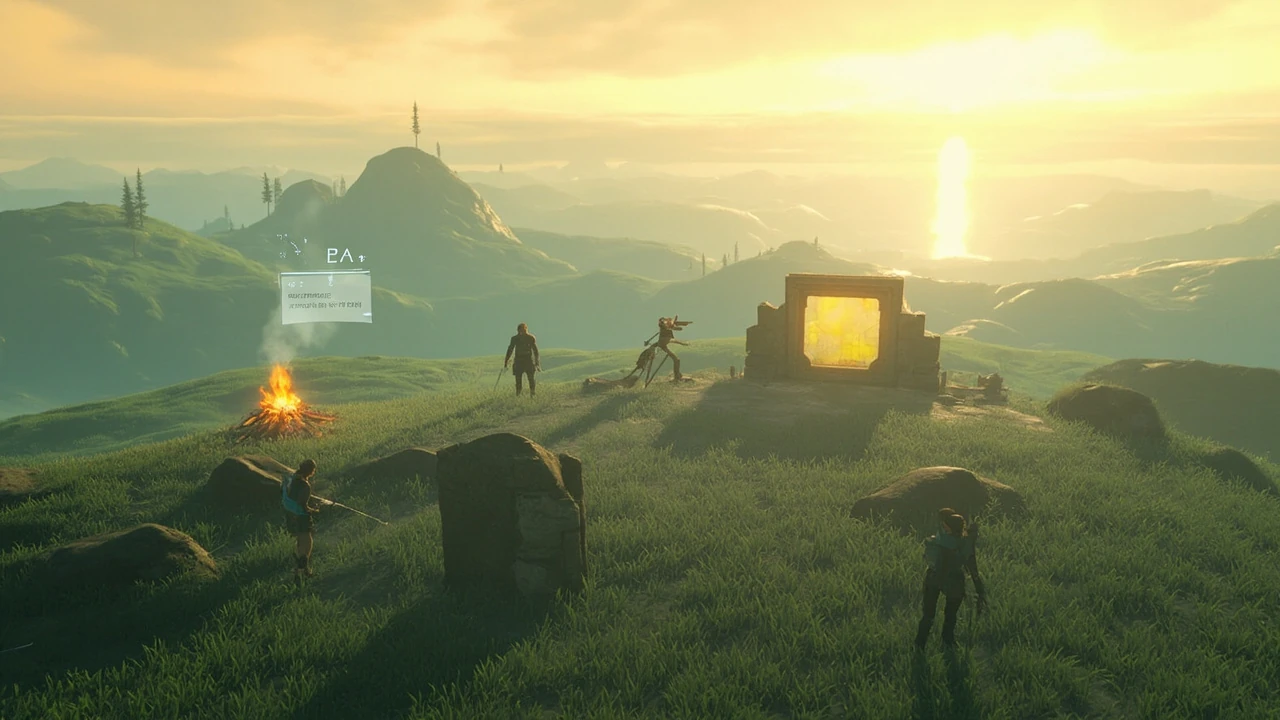
From the ground up BOTW: what the phrase really refers to in Breath of the Wild
The phrase “from the ground up BOTW” is shorthand for a specific design and engineering story inside The Legend of Zelda: Breath of the Wild. It is not a quest, a region, or a downloadable expansion. It describes the way Nintendo EPD rebuilt the Zelda series around a physics-aware open world, starting with terrain and chemistry before the usual Zelda scaffolding of dungeons, heart pieces, and a linear dungeon order. Anyone who has spent a few hours in Hyrule feels the result: fire spreads uphill, rain makes rock slippery, metal attracts lightning, and almost every object can be cut, lifted, or cooked into something else.
For a developer or technical designer, the phrase is more useful than a general appreciation post. It points at a set of interconnected systems, including the chemistry engine, the climbing system, the shrine and shrine quest structure, the weapon durability and inventory rules, and the way those systems constrain level design. Understanding the ground-up approach explains why the world feels readable, why combat stays open even at low health, and why speedrunners can solve shrines in seconds while a casual player might still be chasing a korok.
There is also a production side. Breath of the Wild took roughly five years of main development, with several hundred staff at peak, and the team was explicit in interviews that the early years were spent on a single plateau rather than on a full map. The first playable build was a flat strip with one puzzle, used to test climbing, weather, and fire spread. Once the simulation held up on that strip, the team expanded outward. That origin matters, because it is the literal version of building from the ground up.
Why “from the ground up” is the right frame for the world design
Most open-world games in the mid-2010s still followed a hub pattern. Players travelled to a region, unlocked a story mission, completed a fixed set of activities, then moved on. Breath of the Wild was built the other way around. The development team led by Hidemaro Fujibayashi, with director commentary from Satoru Takizawa, treated terrain and the rules that govern terrain as the first-class citizen. Quests, dungeons, and story beats were placed into a world that was already playable, rather than carving the world around a quest script.
This choice has several practical consequences for anyone studying the game as a developer:
- Gameplay verbs come from systems, not from a scripted interaction list. A sword can cut a tree, Magnesis can lift the log, and physics plus AI then let the player drop the log on an enemy without a designer authoring that exact scenario.
- Failure modes become part of the design space. Stal enemies can pick up dropped weapons, a poorly placed campfire can burn a forest, and a campfire plus wind can produce updrafts that change how the player approaches a tower. The designers did not have to script these outcomes individually.
- Player problem solving is genuine. A shrine puzzle has a designer-authored solution, but in the open world you can frequently reach the same goal through a different system: paragliding from a high peak, building a fire to change wind direction, or using a metal crate as a lightning rod.
- QA shifts from line-by-line scripting to simulation tuning. Bugs become “the simulation produced something the designer did not want” rather than “this trigger is misfired”, and the fix is usually a small tuning pass on tag weights or physics parameters.
The result is a world that reads as a place rather than a sequence. That quality is what the phrase really refers to in BOTW.
The chemistry engine: the layer everything else sits on
At the base of Breath of the Wild is what the community calls the chemistry engine. It is not a single piece of code, but a coordinated set of state machines that track elements and materials on every interactable object. Each object carries tags such as flammable, metallic, wet, frozen, and electric. When an event is triggered, by a fire arrow, a rainstorm, a Magnesis grab, or a lightning strike, the engine walks the tag graph and decides what the affected object should do next.
How an elemental interaction actually fires
Take the classic fire-arrow-and-grass example. The arrow carries a fire tag, the grass carries a flammable tag, and the wind system tracks the local wind vector. When the arrow hits, the engine:
- Detonates the fire source at the impact point and spawns a heat source that decays over time.
- Checks the flammability tag on nearby vegetation, distance falloff, and the local wind vector.
- Schedules ignition on each grass tuft that passes the check, with a small randomised delay so the fire looks natural.
- Adds a smoke particle and updates lighting on affected nodes so the scene reads correctly.
None of that is special on its own. The important part is that the same chain handles less obvious cases. Rain puts out fire and adds the wet tag to wood. Wet wood cannot be lit, so you have to find flint, a high-enough temperature source, or wait for the rain to stop. A wet metal box becomes a conductor and will pull in a lightning strike during a storm, which can chain-damage groups of enemies clustered around it.
Why the chemistry engine matters for designers
For a level designer, the chemistry engine replaces a long list of bespoke scripts. You can drop a campfire, a pile of wood, and a metal chest into a small arena and trust the simulation to produce a fight with several valid solutions. The risk is the opposite: the simulation can produce solutions the designer did not intend, including skipping a shrine puzzle by burning the shrine’s wooden bridge, freezing a switch mid-air with an ice arrow, or using a metal box to short-circuit a magnetic puzzle. The team has said in interviews that they accepted this trade-off and tuned the puzzles around it, rather than constraining the world to prevent the trick.
What the engine does not do well
It is worth being honest about the limits. The tag graph is shallow, so exotic combinations tend to fall back to a small set of behaviours. Burning a metal box does nothing useful because there is no “molten” tag. Lightning does not arc between two metal objects the way it would in a true physics solver. Players who push the system hard will find the seams, and that is normal for a system that was tuned for feel rather than for accuracy.
Terrain, climbing, and stamina: the traversal stack
Traversal in Breath of the Wild is one of the cleanest examples of a single mechanic layered across an entire world. Climbing is technically a single verb with a stamina cost, but it is supported by a deep set of rules that make it feel organic.
The climbing rules the world quietly obeys
Climbing costs stamina based on slope, surface wetness, and the player’s current temperature. Rain reduces friction, which increases the cost and can cause a slip. Wearing the right gear removes or reduces that penalty. The world art team placed visual handholds, ledges, and grass tufts to telegraph where climbing is intended, while the systems team made sure the rules were uniform so the player could predict the cost without consulting a tutorial. The same stamina value drives gliding, sprinting, swimming, and charged attacks, so the player never has to learn a second meter.
Stamina as a global resource
Stamina is shared across climbing, sprinting, swimming, gliding, and weapon charge attacks. This is a deliberate design choice. Because stamina is the bottleneck for almost every traversal verb, the player is constantly making trade-offs about how to spend it. It is the same logic as a crafting resource in a survival game, except the verbs are traversal verbs instead of resource verbs. The player cannot min-max their way out of the trade-off; the world simply presents more terrain than any character can cover without upgrading.
How terrain shape drives the design
Plateaus, ridges, valleys, and rivers are not decoration. They are pacing tools. A long, flat run of grass followed by a steep cliff gives the player a clear reason to cook a stamina-recovery meal, to look for a stable, or to climb. The team has spoken about shaping terrain around traversal verbs rather than around camera shots, which is the opposite of how earlier 3D Zeldas were built.
Shrines, shrine quests, and the small-space design problem
Once the world is set, the next layer is the shrine system. Shrines are small, self-contained puzzle rooms. They replace the long dungeon corridors of earlier Zelda games, which solves several production problems at once.
What the shrine format buys the developer
Shrines give the team a way to test puzzles in isolation, gather metrics on completion rates, and ship new content in smaller batches. They also keep the world surface area high relative to the amount of unique geometry. The same Hyrule field, plateaus, and forests appear in the base game and in both expansions because the puzzles are pushed into the shrines, not the overworld. Each shrine is also a guaranteed performance budget, because the room is small and the props are reused, which made it possible to ship the game on the Wii U without the frame rate collapsing.
Shrine quests as a connective tissue
The shrine quests are the part of the system that most people underestimate. A shrine quest is a small objective in the world that, once solved, reveals a shrine. The shrine itself is a closed puzzle; the quest is an open-ended treasure hunt. This split lets the team author both kinds of design challenge without conflating them. A shrine quest might be as simple as following a diary page that points to a hidden spring, or as fiddly as lifting a metal block on a timer during a rainstorm. The variety is the point, because the same overworld otherwise starts to feel like the same handful of setups.
| Aspect | Shrine quest (open world) | Shrine puzzle (interior) |
|---|---|---|
| Authoring team focus | Quest design, environmental storytelling, wayfinding | Mechanic design, difficulty tuning, gate logic |
| Test surface | Large, mostly untagged, depends on player curiosity | Small, tagged with completion and time metrics |
| Failure cost to the player | Time spent searching, occasional combat | Restart of the puzzle room, stamina or item consumption |
| Typical tools and props | Map markers, NPC dialogue, weather, korok setups | Glyphs, motion control puzzles, Magnesis blocks, motion trackers |
| Performance budget | Shared with the open world scene | Locked per shrine for stable frame rate |
Weapon durability, inventory, and the role of friction
Weapons break. This is one of the most discussed mechanics in the game. From a systems-design point of view, durability is friction. It prevents the player from settling into a single optimal loadout and forces engagement with the inventory and the environment. A master sword that recharges instead of breaking, plus the existence of the climbing gear that does not degrade, shows the team understood that too much friction would shut down specific verbs, so they tuned durability selectively rather than uniformly.
Why weapon durability exists in this specific game
In a world where the player can climb anything, cook anything, and combine almost any element, weapons would otherwise converge on a small set of “best” tools. Durability forces a rotation through weapon types and keeps the player engaged with enemy drops, treasure chests, and the overworld item economy. It also stops a single hit-and-run strategy from dominating combat, because the player cannot rely on a single high-damage weapon for an entire region.
What a designer can learn from the durability numbers
The interesting design point is that durability is not constant across the game. Higher-tier weapons degrade faster, in part because they deal more damage per hit, and in part because the team wanted late-game encounters to feel weighty. Lower-tier weapons last longer, which keeps the early game forgiving. If you are building a similar system, the lesson is that durability should scale with the verbs the player is doing, not with the item’s rarity alone.
Combat, AI, and the “anyone can fight” rule
Combat in Breath of the Wild is built on three pillars: a small set of weapon types, a stamina meter, and a simple AI behaviour tree. Almost every enemy in the game uses the same tree, with different damage numbers, weapon loadouts, and reactions. This is why a low-health run at the edge of the Great Plateau still feels fair: the AI is not smarter, the player is just more limited. Where the game draws on the wider franchise, the relevant background lives in the Legend of Zelda series overview rather than inside this page.
The combat loop is interesting because it is not actually about damage. It is about positioning and the chemistry engine. A player can freeze an enemy with an ice arrow and then hit it with a fire arrow for an instant kill. A player can drop a metal crate on a group, paraglide into a bokoblin camp from above, or use a thunderstorm to clear a camp while somewhere else entirely. The weapons and the AI are the visible layer, but the chemistry engine is the interesting one.
Reading the combat loop as a designer
For a designer, the most useful takeaway is that the combat verbs are all verbs the player already has for traversal and survival. There is no separate “combat mode”. The same Stasis that lifts a water pot can stop a charging lynel long enough to fire an arrow. The same Cryonis that builds an ice ramp in water can be used to block a chokepoint. This is what makes the system feel cohesive: combat is a side effect of how the world works, not its own feature.
| Combat verb | Player action | Underlying system |
|---|---|---|
| Freeze and shatter | Ice arrow, then melee | State tag graph plus physics impulse |
| Lightning chain | Shoot metal object in storm | Electric tag plus weather system |
| Explosive finisher | Remote bomb, red or yellow | Physics impulse plus damage radius |
| Headshot multiplier | Arrow to the head, especially in slow-motion | Hitbox plus damage modifier |
| Stasis reset | Freeze enemy, reposition, release | Object time scaling plus impulse |
| Environmental kill | Push enemy off cliff or into fire | Physics plus state tags |
Cooking, hearts, and the resource economy
Cooking is the second economy underneath the world. Every ingredient has a set of effect tags: hearts, stamina, cold resistance, heat resistance, electric resistance, speed, stealth, and attack up. Combining ingredients in a pot combines the tags, with some rules about overriding and some randomness about how strong the result is. The economy is shallow in the sense that there are only a handful of effects, but it is deep in the sense that the same ingredients can produce very different results depending on the order, the pot, and the weather.
Cooking as a tutorial in disguise
The cooking system also doubles as a tutorial. The first time the player finds a pot, the game shows a short animation. The first time a meal is overcooked or undercooked, the result is still useful, so the player learns the timing. This is one of the cleanest examples in the game of a system teaching itself through consequence rather than through a wall of text. A player who burns a piece of meat on the first try will not feel punished; they will feel prompted to try again with a different timing.
How the cooking economy ties into traversal
Cold resistance, heat resistance, and climbing-related meals are the bridge between the cooking system and the traversal system. The world has a small set of biomes that demand specific meals, and the team tuned those biomes so the player is forced to engage with cooking early. Without a cold-resistance meal or the right armour, the player will take damage on the Hebra mountains. Without a heat-resistance meal, the Gerudo Desert is hostile at noon. The economy is not a separate mini-game. It is a key that unlocks parts of the map.
The “build from the ground up” production pipeline
Production-wise, the team’s tooling and pipeline had to be rebuilt to match the new design. The system that shipped is, by several accounts, the result of a multi-year effort that began in parallel with the Wii U version of the previous 3D Zelda, Skyward Sword. Key production decisions include:
- Long pre-production period focused on a vertical slice of one plateau. The team used that slice to test traversal, climbing, and chemistry before adding art variety.
- Heavy investment in a custom engine toolset. The engine, sometimes referred to in interviews as the Breath of the Wild engine, is a custom build with a Havok-based physics layer and a custom renderer.
- Use of a single shared world build for both the Wii U and Switch versions, with later downgrades and a separate Switch-specific optimisation pass.
- Approval gating around shrines and shrine quests, where individual rooms were tuned for completion time, item use, and failure rate.
- Heavy use of a small pool of high-frequency props. A few dozen tree and rock variants, plus a handful of grass and shrub meshes, cover most of the open world, which keeps memory and streaming budgets under control.
- A unified lighting model that bakes ambient occlusion and other static lighting at build time, with dynamic lights reserved for fire, electric effects, and similar short-lived sources.
None of this is unique on its own, but the order matters. The team fixed the world’s rules before they fixed the world’s content, which is the literal meaning of building from the ground up in BOTW.
Open-world density: how the world stays interesting without padding
One of the trickier design problems in any open-world game is density. If the world is too dense, the player has no downtime. If it is too sparse, the world feels empty. Breath of the Wild uses a small set of high-frequency objects to keep density visually and mechanically high without bloating the asset list.
Koroks, seeds, and the high-frequency layer
Korok puzzles are the obvious example. The team produced around 900 korok setups from a much smaller pool of puzzle patterns: lift a rock, match a set of fruit, complete a small block puzzle, follow a flower trail, race along a moving platform, hold hands with a friend. Each pattern has a handful of variants and a large number of placements. This lets the team reach high density without authoring 900 unique puzzles. The seed reward is also low-stakes, which means the player can ignore most of them without losing access to the inventory upgrade.
Towers, stables, and the navigation layer
Sheikah towers, stables, and shrines are the navigation layer. Towers give map data, stables give fast travel and quest hooks, and shrines give the densest mechanical content. The three layers interact, so a player can choose a horse-and-stable route, a tower-to-shrine route, or a pure exploration route. That choice is itself part of the design. The team did not have to enforce a particular order, because the system rewards several different play styles equally well.
Enemy camps and the encounter layer
Bokoblin, moblin, and lynel camps form the encounter layer. The camps are placed so that the player will run into one before getting bored of any stretch of map, and the camps themselves are designed so a single approach rarely works twice. A bokoblin camp with a few watchtowers plays very differently from a moblin camp with a fire pit in the centre, and a lynel on a ridge plays differently again. The same handful of AI behaviours, combined with terrain and weather, produce a lot of variety.
Weather, time of day, and the simulation layer
Weather and time of day in Breath of the Wild are not cosmetic. They are part of the simulation. Rain makes surfaces slippery, makes lightning strikes more likely, and disables the paraglider in some conditions. Night changes the spawn list of enemies and reduces visibility, which forces a different approach to combat and stealth. The Blood Moon resets the world’s enemy population and any weapon drops in the overworld, which is a soft reset layer tied to a global timer.
Why the Blood Moon exists
From a production point of view, the Blood Moon is a clean way to handle persistent state. The world does not have to track every dropped weapon forever, because the timer guarantees a periodic reset. From a player point of view, the Blood Moon is a narrative beat that doubles as a clear visual signal that the world has been refreshed. That dual use is a useful lesson in tying production constraints to narrative beats: the same system that solves a memory and save-game problem is also the visual cue the player learns to read.
Weather as a stealth and traversal tool
Rain and thunderstorms are also traversal and stealth tools. A storm lets the player sneak past a camp by killing the campfire and lowering visibility, while also opening up lightning tricks for combat. Cold nights in the Hebra region force the player to use fire arrows or a warming elixir, which keeps the cooking economy relevant even at high heart counts.
Audio, music, and the piano-only score as design decision
The audio design in Breath of the Wild is one of the most-cited elements. The score uses a small set of instruments, mostly piano and a small chamber ensemble, and only swells into larger orchestration in very specific places, such as the final boss or the Ballad of the Champions section in the DLC. The rest of the world runs on ambient sound and silence, which makes the world feel lonely and exploratory.
What the audio decision teaches a designer
For a designer, the lesson is that audio can carry a lot of the load in an open world. By holding back the score, the team gives the player more headroom to hear footsteps, wind, fire, and the small sounds of the chemistry engine. The world reads as responsive because the audio is responsive, not because the visuals are dense. A sword hitting metal sounds different from a sword hitting wood, and the player can use that cue to identify what they are about to fight before they see it.
Stinger design and the Breath of the Wild effect
Stingers, the short musical phrases that play when a key is solved, when a Blood Moon rises, or when a major enemy appears, are placed by hand. The team has talked about the difficulty of deciding where to put a stinger without giving away the world. Too many stingers, and the world feels over-directed. Too few, and the world feels dead. The current balance is conservative, with stingers mostly tied to player action rather than to scripted events.
Where the ground-up approach shows its limits
It is worth being honest about the limits of the design, because pretending the system is flawless would not be useful. The same ground-up approach that powers the world also produces a few problems the team did not fully resolve.
- The story arc is sparse. The four Divine Beasts are mechanically similar, and the narrative weight is concentrated in the memory cutscenes rather than in the world itself. Players who value narrative pacing sometimes feel under-served.
- Weapon durability and inventory churn can become annoying in long sessions, especially in Master Mode where enemies heal and weapon drops are tier-restricted.
- The shrines are sometimes too uniform. The team did author some standout shrines, but a long run of motion-control puzzles can feel repetitive in the late game.
- The Blood Moon reset is a useful production trick, but it can feel like a punishment if the player is in the middle of a fight or a stealth sequence.
- Enemy variety in the overworld is thinner than the surface implies. Most late-game encounters are recoloured versions of earlier enemies, and the AI is the same tree, which can make Hyrule feel smaller on a second playthrough.
These are not failures. They are trade-offs that come with a ground-up world. When you build the world before the content, the content has to fit the world’s grain, which constrains the kind of content you can ship.
How the expansions and the sequel reused the same systems
The two expansions, The Master Trials and The Champions’ Ballad, and the sequel, Tears of the Kingdom, all sit on the same system stack. The expansions added the Master Cycle, the One-Hit Obliterator, the Trial of the Sword, and the Champion abilities. These are all extensions of existing systems, including weapon durability, the hero’s path tracker, and the paraglider. The DLC did not introduce a new traversal verb because the world was already at a saturation point for new verbs.
Tears of the Kingdom took the same ground-up approach and added the Ultrahand ability, the Fuse mechanic, and the depths. The lesson is that the system stack is durable: you can add a new verb to the player, like building, without re-authoring the world. The world does not need to know about Ultrahand to feel right, but the player does, which is why the tutorial is the part of the sequel that took the most iteration. The team’s interviews about TotK point to the same plateau-first pre-production, this time with a vertical slice built around Ultrahand and Fuse on a single test area before the rest of Hyrule was filled in.
Lessons for other open-world projects
For teams trying to apply the ground-up approach to a different genre or a smaller budget, the takeaways are concrete. First, pick one traversal verb and one interaction system, and tune them on a flat test scene before any art is added. Second, build a small tag graph for objects rather than a long list of scripted interactions, and accept that the simulation will produce some outputs the designer did not want. Third, keep the navigation layer (towers, map reveals, fast travel) simple, so the player can reach the interesting content without a long tutorial. Fourth, design the small-space content (shrines, dungeons, encounters) to plug into a system the world already supports, rather than to introduce a new system. Fifth, treat audio as a load-bearing part of the world, not as polish at the end. None of these are unique to Breath of the Wild, but the order and the discipline are the parts that travel well.
Frequently asked questions
What does “from the ground up BOTW” actually mean?
It refers to the way Breath of the Wild was designed and built, starting from terrain, the chemistry engine, and the traversal stack, before layering shrines, quests, story, and the rest of the world on top. It is a shorthand for the systems-first design approach the team used.
Is there an official “build from the ground up” mode or quest in the game?
No. It is not a quest, a region, or a DLC. It is a phrase used in interviews and by the community to describe the design philosophy. If a guide claims a specific quest with that name, it is interpreting the phrase loosely.
How did the team build the world for both Wii U and Switch?
According to public interviews and the official Zelda development history, the team worked from a single shared world build, then added a Switch-specific optimisation pass and a separate Wii U target. Art teams worked on resolution, draw distance, and asset LODs to keep the frame rate stable on the weaker hardware.
Why does the world feel so different from older Zelda games?
Because the world is driven by simulation rather than by a scripted adventure. Fire, weather, electricity, and physics are real systems in the simulation, so the world reacts to the player in ways the designers did not have to author by hand.
What is the chemistry engine in BOTW?
The chemistry engine is the community name for the set of systems that track element and material state on every object in the world. It is what makes fire spread, metal attract lightning, wet wood refuse to light, and a frozen enemy shatter on impact.
How does climbing work in Breath of the Wild?
Climbing costs stamina based on slope, surface wetness, and the player’s current temperature. Rain increases the cost, and gear that protects against rain or cold reduces it. The world art team placed visual handholds to telegraph where climbing is intended, but the rules are uniform, so the player can predict the cost.
Why do weapons break in BOTW?
Weapon durability is friction. It prevents the player from settling into a single optimal loadout, keeps the inventory interesting, and stops a single combat strategy from dominating. Higher-tier weapons degrade faster, which keeps late-game encounters weighty.
What did the DLC add, and how does it relate to the ground-up design?
The Master Trials added the One-Hit Obliterator, the Master Cycle, and the Trial of the Sword. The Champions’ Ballad added the Champion abilities, four new boss fights, and a final dungeon. Both expansions extend existing systems rather than introduce new traversal verbs, which is consistent with the ground-up approach.
What did Tears of the Kingdom reuse from the system stack?
Traversal, stamina, the cooking system, the shrine system, the Sheikah tower map reveal, and the Blood Moon reset were all reused. The sequel added Ultrahand, Fuse, Ascend, and the depths, but it kept the chemistry engine and the core traversal verbs intact.
Is “from the ground up BOTW” a useful phrase for a developer to learn from?
Yes. It captures a real production decision, not just a marketing slogan. The lesson is to fix the rules of the world before you fix the content, accept that the simulation will produce solutions you did not author, and design the quest and dungeon layers to fit the world, not the other way around.